




EU Issues Guidance Document on the Safety of Food-Imitating Toys and Other Food-Imitating Products
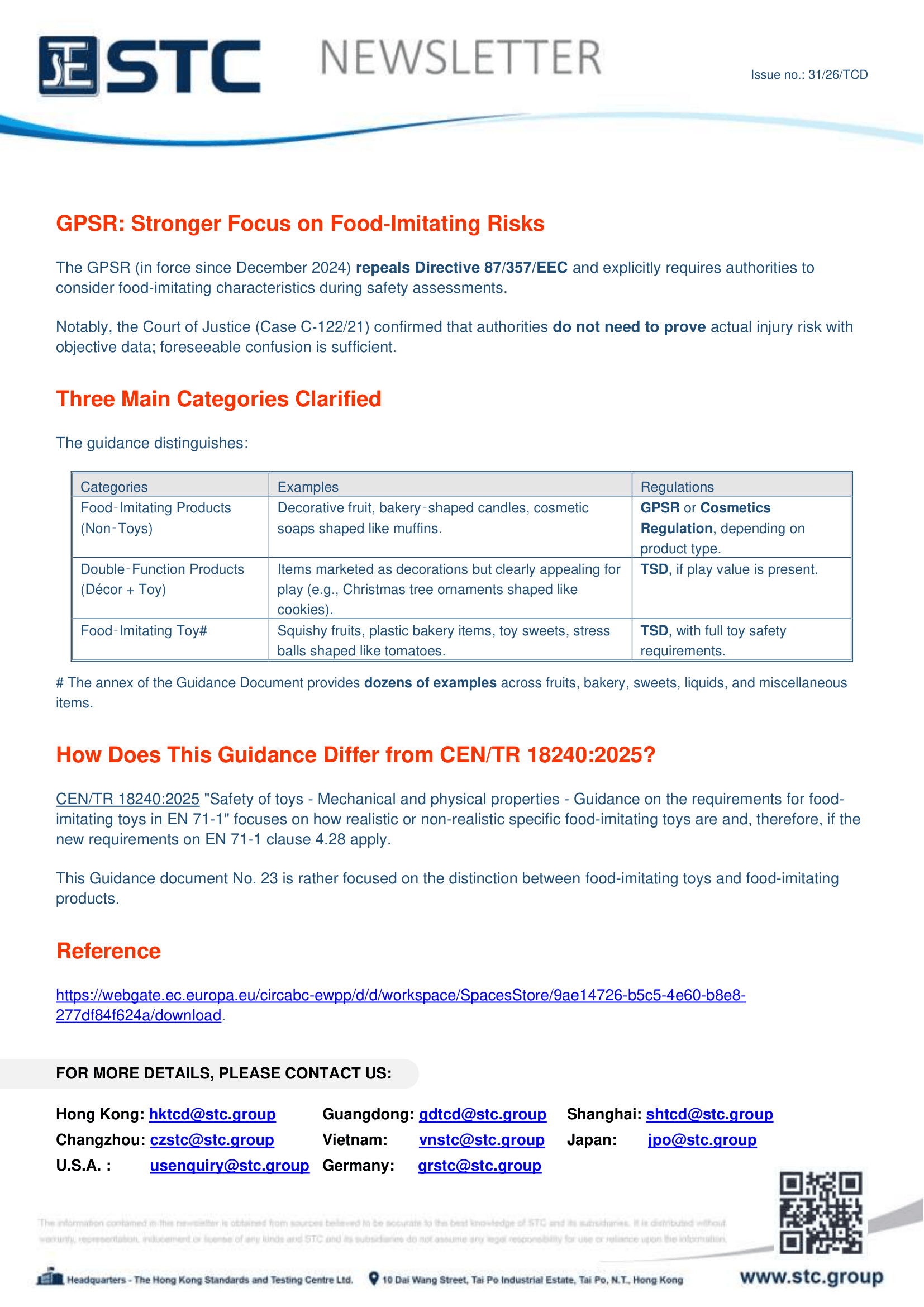
The European Commission has released Guidance Document No. 23 in July 2026, providing practical direction on how to classify food‑imitating toys and other food‑imitating consumer products.
This guidance supports manufacturers, importers, distributors, and market surveillance authorities in determining whether a product falls under the Toy Safety Directive 2009/48/EC (TSD) or the General Product Safety Regulation (GPSR) for the above two categories.
The guidance is non‑binding, but it reflects the consensus approach of the Expert Group on Toy Safety and incorporates insights from the CASP FIP2021 “Handbook of Child appealing (including food imitating) products”.
Risks in Food‑Imitating Products
Food‑imitating products—items that resemble food in form, colour, odour, texture, packaging, or size—may be confused with real food, especially by children. This can lead to suffocation, poisoning, or digestive tract injuries.
Under the GPSR, such products must undergo a risk assessment considering their food‑like appearance and foreseeable misuse.
Distinguishing Toys from Non‑Toys
The TSD defines a toy as any product designed or intended—whether or not exclusively—for use in play by children under 14.
Key determinants include:
- Intended play value introduced by the manufacturer
- Reasonably foreseeable use, which overrides the manufacturer's declaration
- Presentation, marketing, and point of sale (e.g., toy aisle vs. home décor section)
Practical implications
|
Product |
Classification |
Applicable Regulation |
|
A realistic plastic banana sold in a toy department |
Toy |
TSD |
|
The same item sold as home décor |
Non‑toy |
GPSR |
|
Food‑imitating candles |
Non-toy |
GPSR |
|
Food‑imitating soaps |
Cosmetics |
GPSR |
|
Christmas decorations with play value |
Toy |
TSD |
GPSR: Stronger Focus on Food‑Imitating Risks
The GPSR (in force since December 2024) repeals Directive 87/357/EEC and explicitly requires authorities to consider food‑imitating characteristics during safety assessments.
Notably, the Court of Justice (Case C‑122/21) confirmed that authorities do not need to prove actual injury risk with objective data; foreseeable confusion is sufficient.
Three Main Categories Clarified
The guidance distinguishes:
|
Categories |
Examples |
Regulations |
|
Food‑Imitating Products (Non‑Toys) |
Decorative fruit, bakery‑shaped candles, cosmetic soaps shaped like muffins. |
GPSR or Cosmetics Regulation, depending on product type. |
|
Double‑Function Products (Décor + Toy) |
Items marketed as decorations but clearly appealing for play (e.g., Christmas tree ornaments shaped like cookies). |
TSD, if play value is present. |
|
Food‑Imitating Toy# |
Squishy fruits, plastic bakery items, toy sweets, stress balls shaped like tomatoes. |
TSD, with full toy safety requirements. |
# The annex of the Guidance Document provides dozens of examples across fruits, bakery, sweets, liquids, and miscellaneous items.
How Does This Guidance Differ from CEN/TR 18240:2025?
CEN/TR 18240:2025 "Safety of toys - Mechanical and physical properties - Guidance on the requirements for food-imitating toys in EN 71-1" focuses on how realistic or non-realistic specific food-imitating toys are and, therefore, if the new requirements on EN 71-1 clause 4.28 apply.
This Guidance document No. 23 is rather focused on the distinction between food-imitating toys and food-imitating products.
Reference


