




EU Issues Notes About Asbestos in Toy Sands
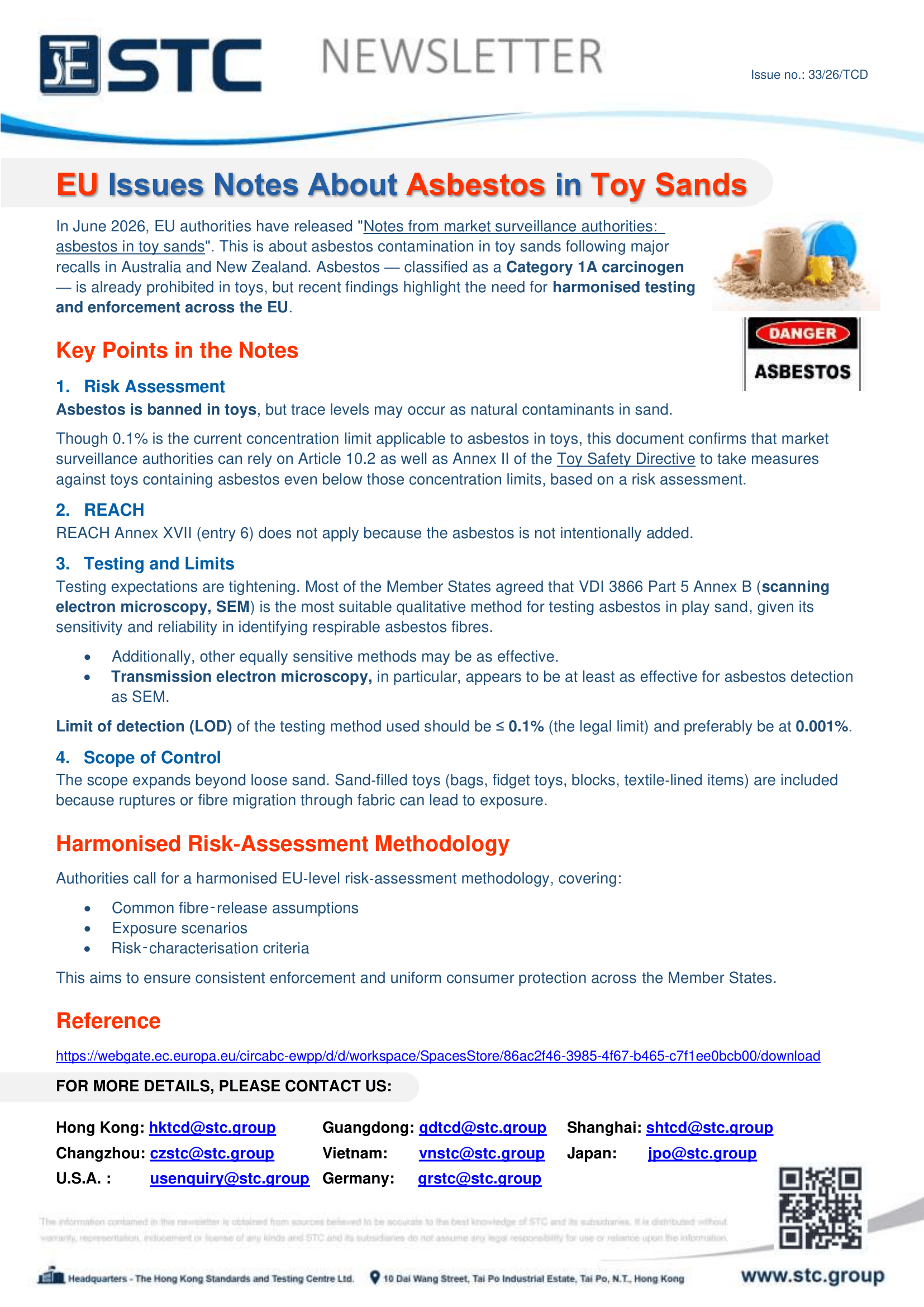
In June 2026, EU authorities have released "Notes from market surveillance authorities: asbestos in toy sands". This is about asbestos contamination in toy sands following major recalls in Australia and New Zealand. Asbestos — classified as a Category 1A carcinogen — is already prohibited in toys, but recent findings highlight the need for harmonised testing and enforcement across the EU.
Key Points in the Notes
1. Risk Assessment
Asbestos is banned in toys, but trace levels may occur as natural contaminants in sand.
Though 0.1% is the current concentration limit applicable to asbestos in toys, this document confirms that market surveillance authorities can rely on Article 10.2 as well as Annex II of the Toy Safety Directive to take measures against toys containing asbestos even below those concentration limits, based on a risk assessment.
2. REACH
REACH Annex XVII (entry 6) does not apply because the asbestos is not intentionally added.
3. Testing and Limits
Testing expectations are tightening. Most of the Member States agreed that VDI 3866 Part 5 Annex B (scanning electron microscopy, SEM) is the most suitable qualitative method for testing asbestos in play sand, given its sensitivity and reliability in identifying respirable asbestos fibres.
- Additionally, other equally sensitive methods may be as effective.
- Transmission electron microscopy, in particular, appears to be at least as effective for asbestos detection as SEM.
Limit of detection (LOD) of the testing method used should be ≤ 0.1% (the legal limit) and preferably be at 0.001%.
4. Scope of Control
The scope expands beyond loose sand. Sand‑filled toys (bags, fidget toys, blocks, textile‑lined items) are included because ruptures or fibre migration through fabric can lead to exposure.
Harmonised Risk‑Assessment Methodology
Authorities call for a harmonised EU‑level risk‑assessment methodology, covering:
- Common fibre‑release assumptions
- Exposure scenarios
- Risk‑characterisation criteria
This aims to ensure consistent enforcement and uniform consumer protection across the Member States.
Reference


